

Date:

24 Oct — 22 Feb, 2024 — 2025

Venue:

Zeyrek Çinili Hamam

ALEKOS FASSIANOS: SAILING TO BYZANTIUM

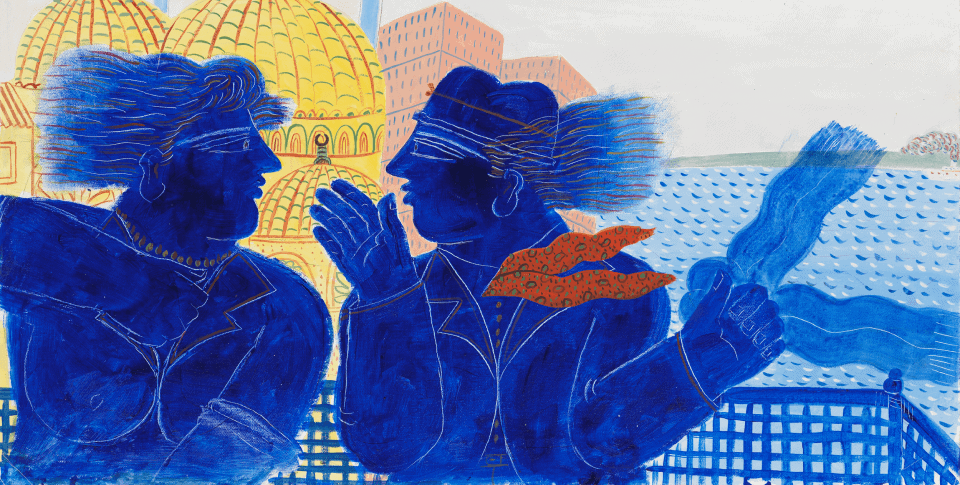
This autumn, the 500-year-old Zeyrek Çinili Hamam will host its first exhibition in its recently discovered Byzantine Cistern, featuring unseen works by Alekos Fassianos as part of a solo show curated by Anlam de Coster in collaboration with Alekos Fassianos Museum and Estate.

Fassianos, a renowned Greek artist whose practice encompasses painting, poetry, ceramic, design, and architecture, is celebrated for his distinctive style that blends ancient art and modernism. His works, characterised by vibrant colours and flowing lines, are deeply rooted in Greek mythology and have the ability to mythologise the quotidian.

Fassianos’ first institutional exhibition in Turkey provides a dialogue between the Works of Fassianos and the multifaceted heritage of the hammam and its cisterns, presenting pieces that engage with Byzantine iconography, the ship graffiti discovered in the cistern and the mysteries that surround them, and the legendary figure of Barbarossa. Fassianos’ works invite viewers to explore a layered dialogue between history, myth, and imagination.

Five major works will be shown for the first time ever in the world, including a painting about Istanbul. Most other works will be shown for the first time outside of Greece.

Held in the enigmatic Byzantine cistern underneath the hammam, the evocative setting conjures new thematic connections with the artist, showing this selection of works together for the first time in response to the history of the hammam. The cistern will continue to serve as a space for contemporary art interventions, complementing the adjacent museum.

Gallery

Alekos Fassianos (25 October 1935 – 16 January 2022) was born in Athens and grew up in a creatively rich environment. His father was a musician, while his mother taught ancient Greek, fostering in him a deep connection to both music and culture. Fassianos studied violin at the National Conservatory before pursuing painting under Yannis Moralis at the Athens School of Fine Arts (1956-1960). In 1960, he was awarded a French government scholarship and moved to Paris, where he studied lithography at the École des Beaux-Arts.

The rise of the Greek military junta in 1967 prompted Fassianos to settle more permanently in Paris. Two years later, his career gained momentum when renowned art dealer Paul Facchetti discovered him. Their collaboration, featuring Fassianos alongside prominent artists such as Jean-Paul Riopelle and Georges Mathieu, played a pivotal role in establishing his reputation. Fassianos’ early solo exhibitions with Facchetti were crucial, offering the first cohesive showcase of the distinctive style that would come to define him. In the 1970s, he joined the prestigious Alexander Iolas Gallery, exhibiting alongside celebrated figures like Max Ernst, René Magritte, Giorgio de Chirico, and Martial Raysse. Over the decades, his work has been shown worldwide, from Malmö to Tokyo and Zurich to New York.

Beyond his painting, Fassianos was a multifaceted artist—engaged in writing, poetry, ceramics, scenography, and architecture. His talents extended to the stage, where he designed costumes and sets for numerous productions, including Franz Kafka’s America at the National Theatre of Athens and Euripides’s Helen in 1980. He also created scenographies for No Exit by Jean-Paul Sartre, among others. Throughout his career, Fassianos illustrated numerous literary works by close friends, collaborating with influential writers, poets, and thinkers such as Constantin Cavafy, Miltos Sachtouris, Louis Aragon, Hamid Fouladvind, Odysseas Elytis, Guillaume Apollinaire, Jacques Lacarrière, Paul Valéry, Fernando Arrabal, and Jean-Marie Drot. His artistic collaborations included limited-edition publications with Bruno Roy founder of Fata Morgana, and publisher André Biren.

Recognized for his contributions to art, Fassianos was made an Honorary Member of the Russian Academy of Arts, and in 2021, he was named Commandeur de l’Ordre des Arts et des Lettres de la Légion d’Honneur.